Introduction
This book teaches the RCE programming language from the beginning. It assumes you can use a terminal and have written a little code in some language. It does not assume you know any particular one.
What RCE is
RCE is a small language for programs whose meaning is fixed by a written specification. A program is a text. Its meaning is a Form: a state machine made of states, events, a step function that takes a state and an event to a new state and some outputs, and a log of the events that happened.
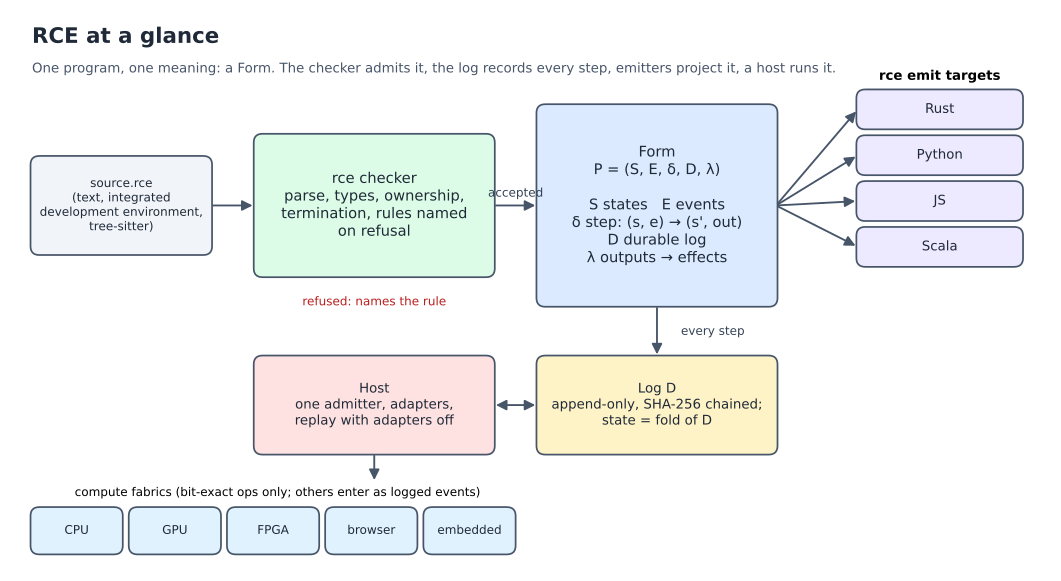
RCE at a glance: the checker accepts a program or names the rule it breaks; an accepted program is a Form; every step goes into the log; emitters project it to other languages; a host runs it. More figures: openIE-dev/rce docs/figures.
Three ideas run through the whole book:
- The same program gives the same answer everywhere. Arithmetic, text and floating point have one defined meaning. There is no undefined behaviour, so a result does not depend on the machine.
- Every program finishes. Loops have a limit, recursion has to make the input smaller, and iterators are counted. A step can never run forever.
- Mistakes are refused before the program runs. The checker refuses a program that could use memory after giving it away, that forgets a case, or whose own tests do not hold. Each refusal names the rule it broke.
Status
The specification is at draft 0.7. That draft is published for review
and can still change. This book teaches language version 0.5, the language
of sections 2 to 10; a module opts into version 0.6 (Appendix C of the
specification) with the first-line comment # rce-version: 0.6, or into
version 0.7 (C.15) with # rce-version: 0.7. What exists today:
- the specification, with its grammar checked by machine;
- a reference checker and interpreter,
rce, which this book uses for every example; - emitters that translate a checked program to Rust, Python or JavaScript.
What does not exist yet: a production compiler and a fast runtime. The reference interpreter defines what programs mean. It is not built for speed.
How the examples are checked
Every program in this book is a file in the listings/ directory of the
book's repository. The chapters include those files directly, so what you
read is what was checked. The script scripts/check-listings.sh runs the
real rce command over all of them:
- a program shown as working must pass
rce test; - a program shown as refused must be refused, with the rule the text names;
- a terminal transcript must match what
rceprints today.
If you find a place where the book and the checker disagree, that is a bug in one of them. Please open an issue.
Conventions
Program text looks like this:
fn half(x: u64) -> u64 = x / 2
A line that starts with $ is a command you type. The lines below it are
what rce printed. The book also shows the exit status, because rce uses
it to say whether something was refused: 0 means success, 1 means refused
or failed, 2 means the command itself was used wrongly.